


13
Venezuela: Opposition politician arrested on explosives charge

Alejandro Pena Esclusa, a 1998 presidential candidate and political opponent of leftist Venezuelan leader Hugo Chavez, was arrested at home by agents from the nation’s intelligence service, the official ABN news service reported Monday. Pena was taken to the intelligence service headquarters for interrogation, ABN said.
Opposition groups say Pena was arrested for political reasons. Unoamerica, a group headed by Pena, said Tuesday his arrest “is part of a Cuban operation that looks to link opposition leaders with terrorist acts.”
Chavez critics have said Cubans are heavily involved in the Venezuelan military and also are playing a key role in intelligence, communications and other areas.
Authorities say they found material of “an explosive nature” when they searched Pena’s home in Caracas, Venezuela.
“We have obtained … some small capsules, more than 100 capsules, which are presumed detonators, some thermal, some electric,” ABN quoted counterintelligence director David Colmenares as saying.
Officials contend Pena has been working with Francisco Chavez Abarca, a Salvadoran resident arrested in Venezuela last week on charges that he was in the country to destabilize the government. ABN calls Chavez Abarca a “terrorist” and says he informed on some of his accomplices.
Pena is one of those accomplices, ABN indicated.
“Alejandro Pena Esclusa is a dark character of the Venezuelan opposition linked to fascist sectors and with a thick file of conspiratorial activities against the government of President Hugo Chavez,” ABN said.
There will be other arrests in coming days as a result of the information Chavez Abarca provided, the news agency said.
Pena’s strong opposition to the Venezuelan president has been lauded, even in the United States. The Alabama state legislature took up a resolution in March commending his actions.
“[A]t great personal risk to himself, Alejandro Pena Esclusa has stood firm in opposition to the spread of Marxism and totalitarianism in Latin America,” the resolution states, adding that Pena “continues to serve as an ideological and symbolic counterweight to Chavez’s grievance driven exploitation of the people of Venezuela and of broader Latin America in furtherance of the fomentation of authoritarian movements in the region.”
Human rights organizations have frequently accused Chavez of intimidating or punishing citizens based on their political beliefs.
In June, the Inter-American Commission on Human Rights sent a letter to Venezuela’s foreign minister, criticizing the government on its record of freedom of expression.
In February, the commission issued a 319-page report accusing Venezuela of routinely violating human rights. The report said that a lack of independence by Venezuela’s judiciary and legislature in their dealings with Chavez often leads to the abuses.
“The report finds that not all individuals are ensured full enjoyment of their rights irrespective of their positions on government policies,” the human rights panel said. “The commission also finds that the punitive power of the state is being used to intimidate or punish people on account of their political opinions.”
The Inter-American Commission on Human Rights is an independent arm of the Organization of American States.
Chavez’s opponents say his government represses political opponents and the expression of free ideas by jailing critics on trumped-up charges or pulling licenses for TV and radio stations and shutting down newspapers. There are about 40 such political prisoners in Venezuelan jails, the critics say.
Most of those prisoners, Chavez critics say, are journalists and former military and police officials and others associated with a short-lived coup against Chavez in April 2002.
Some of the prisoners have been held for long periods without trials or during proceedings that have dragged on for months and even years, the critics say, and they say other prisoners have received harsh sentences under questionable charges. Many of the detainees are held at the secret police headquarters rather than a prison.
“Attacks on journalists were widespread,” said Amnesty International’s 2009 Report on Human Rights in Venezuela. “Human rights defenders continued to suffer harassment. Prison conditions provoked hunger strikes in facilities across the country.”
Human Rights Watch, an independent global organization, issued a 230-page report in 2008 that said Chavez has shown an “open disregard for the principle of separation of powers … specifically, the notion that an independent judiciary is indispensable for protecting fundamental rights.”
The Chavez government has routinely denied any allegations of human rights abuses, saying that authorities arrest citizens only on suspicion of breaking the law.
13
Freedom of expression in Venezuela: Two people arrested for tweeting about banking rumors
After menacing twitter users for their online activities a couple weeks ago, last thursday two persons were arrested, accused of spreading false rumors about the banking system. Those arrested were identified as Luis Acosta Oxford (41), and Carmen Cecilia Nares Castro (35).
Wilmer Flores Trosel, head of the national investigative police unit, declared that there were seized two hard drives, two portable information devices and a cell phone. He also stated that this arrests were the result of a four-month investigation in order to find responsibles to the rumors regarding the national banking system.
These arrests were made under Article 448 of the General Banking Law, which states:
Artículo 448.Las personas naturales o jurídicas que difundan noticias falsas o empleen otros medios fraudulentos capaces de causar distorsiones al sistema bancario nacional que afecten las condiciones económicas del país, serán penados con prisión de nueve (9) a once (11) años.
Art. 448. Any natural or juridical person who spreads fake news or uses other fraudulent methods capable of causing distortions to the national bank system which affect the economic conditions of the country,will be punished with prison, from 9 to 11 years.
However, by the time of the arrest, Acosta Oxford (@leaoxford) had only 32 followers on Twitter, and Nares Castro doesn’t appear to even have an account in the microblogging site. This tweet from @leaoxford’s timeline has been identified as the one which send him to jail:
@leaoxford’s tweet
Gentlemen, don’t say you were not told, withdraw [your money] today from BANESCO, there are few days, you were told”.
It remains unclear how two users with so little influence could be responsible of affecting the economic conditions of the country. Blogger Arnaldo Espinoza made an analysis of the possible influence of Acosta Oxford’s tweet, in Código Venezuela (ES), stating that:
“(…) la detención de Acosta Oxford es un caso típico de amedrentamiento hacia una comunidad que crece exponencialmente y donde existe plena libertad para expresar ideas, pensamientos u opiniones -tampoco es que el tweet se diferencia mucho de otras cosas que se escuchan en esta red social, desde “ollas podridas del gobierno” hasta silencios comprados-. Los 32 followers de Acosta Oxford seguro estarán extrañados por su desaparición. Lo que al resto de la comunidad tuitera preocupa es que existe un constante monitoreo sobre lo que dicen o hacen todos, para pescar al siguiente chivo expiatorio.”
“Acosta Oxford’s arrest is a classic case of intimidation into a community that is growing exponentially and where there is full freedom to express ideas, thoughts or opinions -the tweet is not much different from other things that are heard in this social network, from “government’s rotten pots” to bought silence.(…) What concerns the rest of the twitter community, is that there is constant monitoring of what they all say or do, in order to catch the next scapegoat”
However, detained face a sentence of nine to eleven years of emprisonment, and the usual climate of anxiety seems to have spread to the Internet.
12
Challenging Chavez’s grip on Venezuela: More on Globovision
This blog was originally published by the Washington Post.
During one of his interminable appearances on national television, Hugo Chávez demanded to know last month why Guillermo Zuloaga, the majority owner of Venezuela’s last opposition television station, was not in jail. “How is it possible that he can accuse me of such things and walk free?” the strongman demanded.
The answer is fairly simple: Zuloaga’s statements about Chávez were hardly criminal, and years of government investigations had turned up nothing else prosecutors could plausibly use against him. But that, of course, was not the response of Chavez’s henchmen. Within days of the broadcast, an investigation against the businessman that had been abandoned was reopened; charges were filed. On June 11, a judge ordered Zuloaga arrested and confined to one of the country’s high-security prisons.
By then, the 67-year-old owner of Globovision, an all-news channel that is now the only alternative in Venezuela to government propaganda, was no longer in the country. Like Globovision’s minority owner, another businessman whose bank was taken over by the government three days after the arrest warrant, Zuloaga sought refuge in the United States. Last week he and his son, whose arrest was also ordered, were in Washington, where they were considering making a request for asylum.
“It never crossed my mind that I would be forced to live someplace besides Venezuela,” Zuloaga told me in an interview. “But I can’t be of much help to anyone if I am in a high-security prison. And I think it’s public knowledge that all of the institutions of justice in Venezuela are controlled by the president.”
Zuloaga’s own cases offers vivid proof of that. Judges who have dared to rule in his favor have been summarily fired; charges have been blatantly concocted to serve Chávez’s whim. The case that forced him into exile concerns not the criticism the caudillo complained of but a claim that the broadcaster, who also owns a car dealership, was guilty of “hoarding” his inventory — a charge so ludicrous that Chávez’s own attorney general had dropped it, before scrambling to revive it after the televised diktat.
ad_icon
The attack on Globovision betrays Chávez’s desperation. Alone in Latin America, Venezuela’s economy continues to plunge sharply downward; inflation is at 30 percent; violent crime is soaring. Zuloaga’s journalists have devoted much of their attention in recent weeks to a scandal concerning the spoilage of tens of thousands of tons of food imported by the regime — at a time when shortages of basic goods are widespread.
Worst of all for Chávez, an election — for the National Assembly — is scheduled for Sept. 26. Five years ago a foolish opposition boycott turned the congress into a rubber stamp for Chávez. This year, having hammered together a unity list, the anti-Chávez forces think they could win a majority of the seats. That’s certainly what polls show. The outstanding question is what the government will do — beyond a district gerrymander that has already been imposed — to skew or steal the election.
Silencing Globovision appears to be the beginning of Chávez’s answer. “Legally there is no way the government can close Globovision,” Zuloaga said. “But that doesn’t mean there won’t be an arbitrary decision. Chávez has been trying in any way he can to control the screens of Globovision. They want to inspire fear more than they want to win votes, because they know they have run out of money to buy votes with.”
The crackdown is not without risk. Globovision, seen in more than 2 million Venezuelan homes, is popular. The government’s shutdown of another opposition broadcaster, RCTV, in 2007 provoked nationwide demonstrations and gave birth to an opposition student movement. Already, the arrest order against Zuloaga has caused considerable international condemnation, including from the U.N. rapporteur on free expression and the State Department, which called it “the latest example of the government of Venezuela’s continuing assault on the freedom of the press.”
Zuloaga says Globovision will go on, “as if we are going to be on the air forever.” He, meanwhile, will hope that Chávez cannot do the same. “I really believe what is happening in Venezuela is unsustainable,” he said. “I don’t think people can accept that the quality of life continues to do down the drain. How can that keep on happening?”
9
Chávez Launches Attack Against Cardinal Urosa
Chávez is playing with fire, says the semi-official Vatican newspaper L’Osservatore Romano. The newspaper reported this in reference to the insults the Venezuelan president leveled Monday against Cardinal Jorge Liberato Urosa Savino, the archbishop of Caracas, calling him a “troglodyte” for trying to “scare people about communism.”
“We don’t deserve a cardinal like,” Chávez said during a national assembly on the day his nation celebrates its independence. “This gentleman is unworthy of calling himself cardinal.”
He asked the papal nuncio to Argentina, Archbishop Pietro Parolin, to tell Benedict XVI to replace the current cardinal with Bishop Mario del Valle Moronta of San Cristobal.
L’Osservatore Romano says the president took “advantage of the celebrations of the bicentenary of national independence,” to pour “gasoline on the fire of Church-state relations.”
“Addressing the National Assembly in a solemn commemorative session, Chávez directed very harsh insults to the cardinal, who recently criticized the closing of many of the opposition media and invited the government to respect the democratic rights recognized by the Constitution, insults also repeated in a television broadcast,” reports the Vatican newspaper.
“The Catholic Church in Venezuela firmly rejects the indescribable verbal aggression of which the cardinal archbishop of Caracas has been the object,” states the article, which will appear Thursday in the Italian edition.
In an interview with Globovision network, the secretary-general of the Venezuelan episcopal conference, Auxiliary Bishop Jesús González de Zárate Salas of Caracas, rejected the accusations. He has become the spokesman of the manifestations of solidarity that the cardinal has received from the whole country.
In the same line, the council of priests of the archdiocese of Caracas issued a communiqué, in which it states that, “as a Venezuelan citizen, Cardinal Jorge Urosa Savino has the full right and duty to opine and contribute to the common good, in keeping with his ample cultural preparation and his personal convictions.”
The note continued: “As archbishop of Caracas he has the full right, more than that, he has the sacred duty to guide Catholics on religious and moral principles and values that are at stake in the present social and political situation of our country. This is a part of his office that he cannot give up as principal pastor of our Caracas Church and eminent member of the Venezuelan episcopate.
“In this connection it should be pointed out that all the public statements on topics that affect the collectivity and, hence, the common good, have been very pointed and specific and have been made from the plane of the great principles of the Gospel, and from the systematic application of the latter in the field of social topics, that is, from the Social Doctrine of the Church.”
The council also stated that it rejected Chavez’s attempt to interfer with the internal decision s of the Church by telling the Pope who he should name as archbishop of Venezuela. “The Holy Father, as Universal Pastor of the Catholic Church, enjoys total autonomy and liberty to appoint the bishops for the different diocesan sees in the whole world and to institute the members of the College of Cardinals.
“The clergy of the archdiocese, together with their faithful, reiterate their unbreakable communion with the archbishop of Caracas, Cardinal Jorge Urosa Savino, our legitimate pastor.”
6
Chavez steps up threats against 24/7 Globovision TV
This article was originally published by AP.
Chavez stepped up his threats against Venezuela’s sole opposition-aligned television channel, saying its exiled owners are trying to destabilize his government and he won’t tolerate it.
Chavez called Globovision’s majority owner Guillermo Zuloaga and minority shareholder Nelson Mezerhane fugitive criminals and said he will wait for a while to see if they return to face accusations against them. If they don’t, Chavez said, “we’ll have to think to see what’s going to happen to that channel.”
The government has taken over a bank owned by Mezerhane, Banco Federal, saying regulators detected financial problems. And Chavez has warned that as authorities seize assets to cover deposits, they could go after Mezerhane’s stake in Globovision. He went further on Friday, asking: “How much could Globovision cost? It doesn’t amount to even 1% of all that money its owners took away,” Chavez said. “They took a very large sum of money.”
Attorney General Luisa Ortega said that a court had ordered Mezerhane’s arrest for alleged irregularities in his group of companies. She said authorities believe he took depositors’ money out of the country.
Chavez mockingly suggested the channel’s owners could come to the presidential palace to discuss the predicament over coffee.
Mezerhane, who was in Florida at the time of the bank takeover last month, has called the case political retribution and said he has no plans to return to the country for now. Mezerhane did not immediately respond to the latest accusations by Chavez.
Zuloaga disappeared last month after a court issued an arrest warrant for him and one of his sons. Associates said he left the country, though they didn’t say where he went.
Prosecutors want Zuloaga jailed while he awaits trial on charges of usury and conspiracy for keeping 24 new vehicles stored at a home he owns. Zuloaga, who also owns several car dealerships, has called the charges bogus and says prosecutors are carrying out a political vendetta on Chavez’ orders.
Chavez has often accused Globovision of conspiring against him and trying to undermine his government. He denies holding sway over prosecutors who have brought charges against Zuloaga, or over officials who seized control of the bank.
Globovision has been the only stridently anti-Chavez channel on the air since another opposition-aligned channel, RCTV, was forced off cable and satellite TV in January. RCTV had been booted off the open airwaves in 2007.
Globovision has recently been airing critical coverage of a scandal involving thousands of tons of food found beyond expiration dates and rotting in government storage.
Chavez said station managers “are trying to destabilize the country, following instructions from their fugitive, hidden owners. We aren’t going to permit it.”
6
Imprisoned Venezuelan journalist declares hunger strike
CNN is reporting that Leoncis Garcia, a Venezuelan journalist who has been held for two years without a trial reported that he has gone on a hunger strike, saying he wants the judge in his case to recuse himself. Leocenis Garcia made the announcement June 30 on Twitter. “I am starting an indefinite hunger strike until the Judge Jesus Jimenez of Court 20 stops working on my case,” Garcia said. It was not immediately known why Garcia wants the judge removed.
The journalist was arrested in May 2008 and charged with five offenses, including illegal possession of a firearm, resistance to authority and property damage. Garcia and his supporters say he was really arrested for publishing articles critical of Venezuela’s state-run petroleum industry.
Garcia said in August 2008 that he had been tortured by Venezuela’s secret police, published reports said. He is being held in the Tocuyito prison, and his father has expressed concerns that his son will be killed there. Human rights organizations have frequently accused leftist President Hugo Chavez of intimidating or punishing citizens based on their political beliefs.
In June, the Inter-American Commission on Human Rights sent a letter to Venezuela’s foreign minister, criticizing the government on its record of freedom of expression.
At issue were three cases, including the conviction and sentencing the previous week of journalist Francisco “Pancho” Perez to nearly four years in prison and a fine of more than $18,000 for defamation of public officials.
The charges were brought because of a 2009 newspaper column published in the city of Carabobo that highlighted many of the mayor’s family members who were hired as contractors by the local government.
“The evident disproportion of the sentence handed down for the publication of a piece that was clearly in the public interest demonstrates the serious state of vulnerability in which freedom of expression in Venezuela finds itself,” the commission said in a statement.
In February, the commission issued a 319-page report accusing Venezuela of routinely violating human rights. The report said that a lack of independence by Venezuela’s judiciary and legislature in their dealings with Chavez often leads to the abuses.
“The report finds that not all individuals are ensured full enjoyment of their rights irrespective of their positions on government policies,” the human rights panel said. “The commission also finds that the punitive power of the state is being used to intimidate or punish people on account of their political opinions. The commission believes that conditions do not exist for human rights defenders and journalists to be able to freely carry out their work.”
The Inter-American Commission on Human Rights is an independent arm of the Organization of American States.
Chavez’s opponents say his government represses political opponents and the expression of free ideas by jailing critics on trumped-up charges or pulling licenses for TV and radio stations and shutting down newspapers. There are about 40 such political prisoners in Venezuelan jails, the critics say.
Most of those prisoners, Chavez critics say, are journalists and former military and police officials and others associated with a short-lived coup against Chavez in April 2002.
Some of the prisoners have been held for long periods without trials or during proceedings that have dragged on for months and even years, the critics say, and they say other prisoners have received harsh sentences under questionable charges. Many of the detainees are held at the secret police headquarters rather than a prison.
“Attacks on journalists were widespread,” said Amnesty International’s 2009 Report on Human Rights in Venezuela. “Human rights defenders continued to suffer harassment. Prison conditions provoked hunger strikes in facilities across the country.”
Human Rights Watch, an independent global organization, issued a 230-page report in 2008 that said Chavez has shown an “open disregard for the principle of separation of powers … specifically, the notion that an independent judiciary is indispensable for protecting fundamental rights.”
“In the absence of credible judicial oversight,” Human Rights Watch said, “the Chavez government has engaged in often discriminatory policies that have undercut journalists’ freedom of expression, workers’ freedom of association and civil society’s ability to promote human rights in Venezuela.”
The Chavez government has routinely denied any allegations of human rights abuses, saying that authorities arrest citizens only on suspicion of breaking the law.
1
Caracas Archbishop says that Venezuela is on its way to downfall
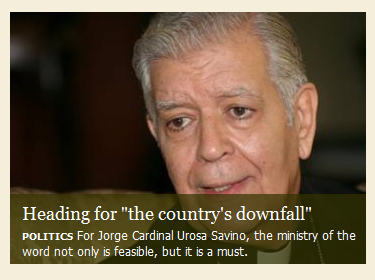 Great interview published by El Universal to Jorge Cardinal Urosa Savino, Caracas Archbishop about the current situation in Venezuela:
For Jorge Cardinal Urosa Savino, the ministry of the word not only is feasible, but it is a must, mostly nowadays, when, in his view, “the intended way to take us is dictatorship and the country’s downfall.” He noted his dislike of permanent exposure to the media, yet feels the need to speak to the country.
The communiqué from the presidency of the Venezuelan Bishops’ Conference on the spoiled food is noteworthy because it refuels the controversy under which the boundaries between the spiritual mission of the Catholic Church and its interference in politics are so blurry, to such an extent that it is accused of dealing with matters which are not their business.
Politicians say so whenever what one says is not appropriate for them. Bishops’ remarks on social and political life always are in line with supreme principles. We do not go into circumstantial details, except for the result of a government wrongful behavior. The statement referred by you is in accordance with our mission as shepherds of the people of God. In addition, we, bishops, are fully entitled, as citizens, to give our opinion, particularly when the common good, freedom, justice and peace are at stake.
Therefore, the Church is worried not only about a breaking point, such as spoiled food.
It is a breaking point, but a heavy one. Not only hundred thousand tons of food has been lost, but also what does this mean. Firstly, there is likely administrative corruption; further, inefficient management of activities which should correspond to individuals. All of this happens because the government, which tries to cover all areas, is in a totalitarian fashion and going beyond its own tasks, such as ensuring personal and material security of citizens, good working order of public utilities, sovereignty and the country’s independence. Thus, the government has embarked upon production, distribution and marketing of every kind of goods. It attempts to take part in all aspects of Venezuelans’ lives by imposing a Marxist-communist line.
Should the government be efficient and honest in management of the property taken over, would the Venezuelan Church have the same reporting position?
No matter what efficient and honest, it would be fulfilling functions that should correspond to individuals, who, according to the Constitution have the right to engage in economic activities. Such intervention in all the fields of economy, going beyond necessary controls, is an expression of the Marxist-communist line intended to be imposed by the president (Hugo Chávez), which, incidentally, was refused by the people on December 2, 2007 (in a referendum on the constitutional reform). Marxist totalitarianism allows those who occupy top government positions absolute control over the rest of people and this is something questioned by the Church social doctrine, because it leads to gross injustice and people’s submission to the government.
While totalitarianism fills the political, economic and social life, it also enters family life and individual intimacy. Are we reaching such extreme cases in Venezuela? Is it time to chase the Catholic religion?
I hope not, but we are on that way. There is surely the attempt at taking hold of people consciousness, but they have not made it because there is a strong democratic spirit in most Venezuelans.
Was Jesus Christ, as President Chávez claims, the first socialist in the history?
There is a big mistake here. Jesus Christ was not a socialist or monarchist or republican or liberal or a political leader. He was a religious leader; more precisely, the son of God becoming a man. He is above any system, ideology or regime. Such remarks aim at misleading people’s religious feelings. Jesus Christ promotes fraternal love, justice, the human being’s magnanimity. The values proposed, forcefully, by this socialism put power not in the people’s hands, but in their leaders’; remove pluralism, any dissent and different opinions not necessarily opposed to the government thinking.
29
In Venezuela Twitteres, bloggers, and forum members in the eye of the justice
This blog post was written by Marianne Diaz, Venezuelan lawyer and fiction writer, blogger for Amnesty International on Human Rights issues, she focuses on gender, poverty and work issues, and freedom of speech and information. This entry was originally posted by Global Voices Advocacy.
The long wave of interventions to banks in Venezuela, has led, inevitably, to lots of rumors about which banking institution is soon to be intervened. The Federal Bank, seized last week, is the twelfth bank intervened by the government since November 2009.
A week ago, venezuelan Vice-President, Elias Jaua, declared that President Hugo Chávez ordered the Ministry of Interior and Justice to initiate a thorough and systematic investigation in order to identify the sources of the rumors about the instability of private banking. Jaua stated that generation of rumors is a “crime punishable by imprisonment from nine to 11 years” and warned that participants of “digital forums that have become centers of political conspiracy” will be punished. Meanwhile, the Minister for Interior and Justice, Tarek El Aissami, said “We are on the trail of those responsible for manipulation and terrorism.“
Likewise, the chairman of the Banking Association of Venezuela, Juan Carlos Escotet, supported the measure, and warned that online social networks “in no way can lend themselves to spread rumors that are expressly provided as a crime under the General Banking Law.” Escotet added that those who generate such information, “by any means, Twitter, text messages, or through any media” would be committing a crime. The above mentioned General Banking Law states the following:
Artículo 448.Las personas naturales o jurídicas que difundan noticias falsas o empleen otros medios fraudulentos capaces de causar distorsiones al sistema bancario nacional que afecten las condiciones económicas del país, serán penados con prisión de nueve (9) a once (11) años. Art. 448. Any natural or juridical person who spreads fake news or uses other fraudulent methods capable of causing distortions to the national bank system which affect the economic conditions of the country,will be punished with prison, from 9 to 11 years.
Although it’s evident that with every right comes a responsibility, several users have manifested their disagreement with this announcement, specially because of its consequences over the online behavior, caused by fear. We may recall that Chavez’s previous threatens against those bloggers who published information about the black market of dollar in Venezuela, led to the self-shutdown of the most popular blogs on the subject in the country. However, the venezuelan twitter community remains very unpleased with this measure.
Apparently, it’s not the law itself what is bugging twitterers and bloggers, but the government’s alleged disproportion in choosing which behaviors apply it to, and that it seems that lately, citizen’s online behavior is more of a concern than hunger, poverty and insecurity. However, it might be the suitable moment to remember that several websites, such as Noticiero Digital, already had policies regarding suspension of their forum users who speaked about banking rumors.
If anything, this isn’t the first time something similar happens. Last year, in Guatemala, a citizen was arrested for the crime of “fiscal panic“, and in Seúl, a blogger was also imprisoned for spreading financial rumors.
24
Chávez Ramps Up Efforts to Silence Critics
Freedom House condemned ongoing efforts by the Venezuelan government to bring criminal charges against the owners of Globovision, the only remaining independent television station in the country. Freedom House called the continuing persecution of the station’s ownership a transparent effort to silence one of the few remaining voices that are willing to criticize the policies of Chavez in advance of upcoming parliamentary elections.
Two major shareholders in the private television station have recently come under pressure from the Chavez administration. Co-owner Guillermo Zuloaga was forced to flee the country to avoid arrest on charges many believe to have been fabricated by the government. Additionally, the government took over the bank of another shareholder, Nelson Mezerhane, and threatened to seize Mezerhane’s Globovision shares as part of the bank takeover. Currently in Florida, Mezerhane cannot return to Venezuela without fear of arrest.
“President Chavez’s denial that these actions are politically motivated would be more credible if not for his systematic efforts over the last decade to close the space for independent voices, particularly the voices of those who oppose his policies,” said Paula Schriefer, director of advocacy at Freedom House. “Chavez’s continued intolerance for criticism only serves to further weaken what little is left of Venezuela’s democratic credentials.”
Frank La Rue, special rapporteur at the United Nations for freedom of expression, denounced the “harassment” of Zuloaga and said that the arrest warrant was “politically motivated, aimed solely at silencing Zuloaga.”
Reports of crack-downs on independent media have continually plagued Venezuela during the Chavez administration but have increased in intensity as the opposition prepares for parliamentary elections in September. Venezuela dropped two points this year in Freedom of the Press due to increased violence against journalists and the closing of more than 30 radio and television stations under the controversial Law of Social Responsibility in Radio and Television.
Venezuela is ranked Not Free in Freedom of the Press 2010 and Partly Free in Freedom in the World 2010, Freedom House’s survey of political rights and civil liberties.
For more information on Venezuela, read: