


6
CPC seeks compensation from Venezuela over oil dispute
State-owned oil company CPC Corp. Taiwan said Saturday that as its request for international arbitration regarding a dispute with Venezuela over oil exploration was accepted last month, it is claiming more than US$80 million compensation from Venezuela’s state-owned oil company.
CPC filed its arbitration request with the World Bank’s International Center for Settlement of Investment Disputes (ICSID) two years ago, after Chavez’s government and its oil firm, Petroleos de Venezuela (PDVSA) , nationalized all foreign-owned oilfields and took over many enterprises in 2007.
As CPC has invested nearly US$80 million in two oilfields in Venezuela — the Gulf of Paria West and Gulf of Paria East blocks — the compensation claims will be much higher than the company’s original investment, said CPC Vice President Lin Maw-wen.
Lin said his company hopes the final compensation figure will also include prospective profits from the oilfields, but he declined to reveal any figures during the negotiation process.
CPC made it clear in 2007 that it would not accept Venezuela’s demand to take over the two oilfields, even if its Venezuelan counterpart was willing to offer higher prices, saying that “oil is more important than money.”
Taiwan imports more than 99 percent of all the oil it consumes. The crude comes from long-term oil suppliers as well as from CPC’s overseas oilfieldsCPC seeks compensation from Venezuela over oil dispute.
6
Problems in Venezuela with the Electricity supply at a crossroad
While the looming collapse or shutdown of the Guri dam has been overcome thanks to the blessing of the rains, the National Electrical Grid (SEN) is at a “turning point,” José Aguilar, an engineer and international electricity advisor, said.
Other experts warn against considerable vulnerability in distribution and transmission components; hence a fitful service nationwide. Aguilar made specific reference to the unbalance or break of electric power generation in Venezuela.
In the expert’s view, the grid is already “at a crossroads.” “For the first time, there is less and less power available in the hydroelectric system, compared with the thermal electric generation system. This is basically because in three and a half years it was destroyed what took decades to build to the country’s benefit.”
Aguilar explained that multiple factors have led to such an “unthinkable” scenario, such as “overexploitation of the Guri dam; a neglected, chronically deteriorated and lagged behind the thermal electric system including projects that have not been implemented and less maintenance than needed.” In addition, the expert said, “the grid operating margin have been undermined due to the growing demand, as a result of the energy gap and the National Electricity Rationing Plan,” effective until June 10.
Such a “serious situation reduces the grid operations and severely restricts the operating range to implement the required maintenance shutdown in the face of a fast deterioration rate in both types of electric power generation. Therefore, two big blocks of thermal electric power are promptly needed. Distributed generation is not the solution.” “We have reached the limit of the operational range; additional failures at the Guri dam would unleash even a more acute energy gap,” the specialist in hydrothermal units noted.
2
Chavez Crackdown on Brokerage Leaves Traders Jobless
This article was first published by Bloomberg Business Week.
Trader Jofmar Heredia was thrown out of work when Venezuelan President Hugo Chavez shut the unregulated currency market in May and seized about 40 brokerages, accusing them of setting artificial rates, capital flight and money laundering.
Heredia, 31, said she’s worried she may never find a job at a bank again because of Chavez’s crackdown.
“I’m unemployed and leaving my resume in banks but no one is calling,” said Heredia, who worked at Proinversion Sociedad de Corretaje CA in Caracas. “A lot of my friends in brokerages taken over by the government have been let go.”
The brokerage business is in danger of becoming obsolete in this socialist nation, said Noris Aguirre, president of clearing firm Caja Venezolana de Valores. Since November, Venezuela’s securities regulator has taken control of about 35 percent of the 112 trading firms and closed four after they were blamed for the 27 percent drop in the bolivar through May 18. That may leave up to 2,500 without jobs even as Chavez says his biggest economic priority is preserving employment.
Chavez, a 55-year-old former paratrooper who’s been in power for 11 years, said the country doesn’t need such companies and accuses them of exploiting loopholes to become rich. The government banned investment instruments known as mutuos in February — which are akin to repurchase agreements, or repos — and prohibited brokers from trading in a new currency market established last month. Securities firms use repos to borrow money to finance positions in bonds and other securities.
In a speech on May 23 to supporters, Chavez said his country should eliminate brokerages.
Chavez Takes Control
“We’re going to respond strongly against these thieves that are trying to wash their hands now,” Chavez said. “There’s no economic reason for the weakening of the bolivar. It’s a huge fraud against the republic.”
The government took control of the country’s largest brokerage, Econoinvest Casa de Bolsa, after raiding it on May 24, arresting four directors and ordering it to cease operations for a week pending an investigation. Of the 420 workers at the company, 126 have resigned, according to the nation’s regulator. The directors are being held at the national intelligence service in Caracas awaiting final charges against them for illegally trading foreign currency and association with delinquency.
Rene Buroz, the lawyer for the directors, declined to comment, as did an Econoinvest public relations official, who asked not to be identified in accordance with company policy.
No Opportunities
Nelson Venero, a 32 year-old accountant, lost his job at the end of May after working for five years in the brokerage industry. After securing a job at AVC Valores Sociedad de Corretaje and a pay raise with a dollar bonus in October, he said he was fired after the government seized the company in May.
“This limits operations so much for brokerages that I don’t see any opportunities for them,” Aguirre of Caja Venezolana de Valores, which helps manage bonds and equities owned by brokerage houses, said in an interview. “They’re allowed to buy and sell company shares, but all of the companies that traded on the stock market have now been nationalized.”
Chavez nationalized Cia Anonima Nacional Telefonos de Venezuela, the phone company known as Cantv, in 2007 to boost the state’s hold on the economy. The government has also taken over assets from Exxon Mobil Corp., ConocoPhillips, Ternium SA and Mexican cement maker Cemex SAB, which listed on the Caracas Stock Exchange.
Unregulated Market
The brokerage industry boomed between 2005 and 2010, growing 42 percent to more than 100 institutions, according to the securities regulator. Traders were hired to perform bond swaps as a means of obtaining dollars for companies that failed to receive government authorization to buy at the official exchange rate.
The bond trading set an implicit unregulated rate. That rate plunged to 8.2 per dollar on May 11, seven days before Chavez shut down that market.
The central bank re-opened the market on June 9, setting the maximum rate and limiting the amount of dollars for purchase. The average rate is now about 5.3 bolivars per dollar. In addition, there are two official exchange rates of 2.6 bolivars per dollar and 4.3 per dollar for imports.
“This was destined to happen,” said Roberto Gonzalez, 39, a former partner at a Caracas-based brokerage who left the firm last year. He declined to identify the company.
Tough Environment
Tomas Sanchez, president of the securities regulator known as CNV, said the number of brokerages will likely be cut to less than 20 and that most of the unemployed traders may be able to live off savings since they earned commissions in dollars.
“We know some workers will be affected by this situation but they enjoyed exorbitant benefits and have savings,” Sanchez said in an interview in Caracas on June 9. “Maybe the secretaries and couriers can be incorporated into the public banking system.”
Heredia said that she wasn’t paid in dollars and received a commission of about 10 percent of the value of bolivar transactions.
Raul Maestres, a consultant at Korn/Ferry International, an executive search firm, said their offices in Caracas have been inundated with resumes.
“It’s not the best moment to find work,” Maestres said.
Venezuela’s unemployment rate rose to 8.1 percent in May, from 7.7 percent a year earlier, as the economy slid into the first recession in seven years. Gross domestic product shrank 3.3 percent last year and will likely contract 2.5 percent this year, according to the median forecast in a Bloomberg survey.
Broker ‘Blackmail’
Brokers are “not going to blackmail us with the idea that this is going to hurt employment,” Ricardo Sanguino, the president of the congressional finance committee, said in an interview. “Many of them acted outside the law and created more problems than benefits.”
Venero, the unemployed accountant, said that he feels powerless to find work and that he may take a broker course in Panama, where Venezuelan banks have opened branches.
“I don’t think I’ll find work in the capital markets because they’ve been very hard hit,” he said in a phone interview. “A lot of friends are out of work.”
1
Chavez formalizes seizure of US-owned oil rigs
Article originally posted on BusinessWeek
Chavez government took control of 11 oil rigs owned by U.S. driller Helmerich & Payne on Thursday after the company shut them down because the state oil company was behind on payments.
The government’s “forced acquisition” of the rigs took effect with publication of President Hugo Chavez’s decree in the Official Gazette. Red-clad Chavez supporters celebrated the takeover in an outdoor rally in the town of Anaco, where some of the rigs are located.
The government has said it decided to seize the oil rigs because Helmerich & Payne had left them idle for about a year.
Oil Minister Rafael Ramirez defended the expropriation on Wednesday, telling state television the Tulsa, Oklahoma-based company had refused to discuss rates for its drilling services. He said the state oil company Petroleos de Venezuela SA, or PDVSA, is willing to discuss a fair price for the drills and if no agreement is reached, the matter will go to arbitration.
Helmerich & Payne has said it halted operation of some rigs because it simply wanted to be paid for its work.
The U.S. company announced in January 2009 that it was halting about four of its drilling rigs because PDVSA owed the company close to $100 million. Several months later it said more of its rigs were out of operation due to the unpaid debts.
The company said in a statement last week that PDVSA still owed it about $43 million as of June 14.
Other oil services companies have complained about delayed payments. Dallas-based Ensco International Inc. said last year that it had suspended oil drilling off Venezuela’s Caribbean coast because Venezuela owed it $35 million — prompting the state oil company to take over the its operations.
Starting in 2008, PDVSA accumulated unpaid debts of about $7.5 billion to oil industry service contractors. The state oil company paid off more than $5 billion of those debts in 2009, partly relying on bonds to cover its obligations.
30
Venezuela in more trouble than Greece
 Article originally posted by Bloomberg.
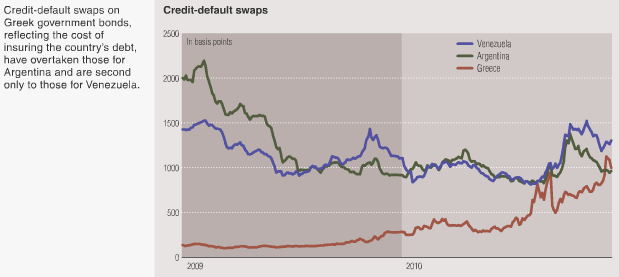
The cost of insuring Greek government debt is now second only to that of Venezuela, where Chavez has declared “economic war” against the “bourgeoisie.”
The CHART OF THE DAY shows that credit-default swaps on Greek government bonds, in red, have overtaken Argentina, which failed to pay more than $80 billion in December 2001. The Latin American nation still has more than $6 billion of defaulted securities outstanding after its second attempt to restructure.
“Greece isn’t Argentina,” said Niels Jensen, a portfolio manager at London-based investment firm Absolute Return Partners LLP, which oversees more than $300 million. “From an economist’s point of view, there’s no question that it’s much, much worse.”
Greece’s debt burden last year was equivalent to about 115 percent of gross domestic product, compared with a level of about 60 percent for Argentina when it defaulted. Credit swaps signal there’s a more than 67 percent chance the southern European nation won’t meet its commitments within the next five years.
Venezuela’s Chavez, a 55-year-old former army paratrooper who champions a socialist ideology, oversees an economy that may contract 2.5 percent this year, according to Bank of America Corp.
“You’ve declared an economic war against me, so I accept your challenge, stateless bourgeoisie,” Chavez said June 2 after business chambers criticized his handling of the economy. “I’m declaring an economic war with the help of the people and workers.”
Credit-default swaps pay the buyer face value in exchange for the underlying securities or the cash equivalent should an issuer fail to adhere to its debt agreements.
25
Exxon Comes Out Ahead In Arbitration Despite Venezuela’s Claims
Article published by the Wall Street Journal
The latest decision from an arbitration panel has given Exxon Mobil Corp. (XOM) an edge over its battle to extract compensation from Venezuelan President Hugo Chavez.
Legal experts say the June 10 decision by a World Bank-affiliated international dispute center allows Exxon to proceed in its claim to be paid for oil-producing assets, estimated to be worth billions of dollars, expropriated by Venezuela in 2007. The decision also bodes well for other companies that are pursuing similar claims against Venezuela, the one the top world’s top 10 crude oil producers.
24
Venezuela’s Restrictive Forex System Threatens Economy
Article originally published by the Wall Street Journal
Venezuelan businesses are struggling to access U.S. dollars due to the South American country’s new, tightly controlled currency exchange system, which is likely to cause an economy already deep in recession to shrink even more.
Venezuelan economic output has contracted for the previous four quarters, falling an annual 5.8% during the first three months of this year alone. Yet the government of President Hugo Chavez has made few efforts to stimulate growth. On the contrary, recent, business-unfriendly actions by the self-proclaimed “revolutionary” government are digging a deeper hole, economists warn, despite an uptick in prices for oil, Venezuela’s …
24
Chávez Ramps Up Efforts to Silence Critics
Freedom House condemned ongoing efforts by the Venezuelan government to bring criminal charges against the owners of Globovision, the only remaining independent television station in the country. Freedom House called the continuing persecution of the station’s ownership a transparent effort to silence one of the few remaining voices that are willing to criticize the policies of Chavez in advance of upcoming parliamentary elections.
Two major shareholders in the private television station have recently come under pressure from the Chavez administration. Co-owner Guillermo Zuloaga was forced to flee the country to avoid arrest on charges many believe to have been fabricated by the government. Additionally, the government took over the bank of another shareholder, Nelson Mezerhane, and threatened to seize Mezerhane’s Globovision shares as part of the bank takeover. Currently in Florida, Mezerhane cannot return to Venezuela without fear of arrest.
“President Chavez’s denial that these actions are politically motivated would be more credible if not for his systematic efforts over the last decade to close the space for independent voices, particularly the voices of those who oppose his policies,” said Paula Schriefer, director of advocacy at Freedom House. “Chavez’s continued intolerance for criticism only serves to further weaken what little is left of Venezuela’s democratic credentials.”
Frank La Rue, special rapporteur at the United Nations for freedom of expression, denounced the “harassment” of Zuloaga and said that the arrest warrant was “politically motivated, aimed solely at silencing Zuloaga.”
Reports of crack-downs on independent media have continually plagued Venezuela during the Chavez administration but have increased in intensity as the opposition prepares for parliamentary elections in September. Venezuela dropped two points this year in Freedom of the Press due to increased violence against journalists and the closing of more than 30 radio and television stations under the controversial Law of Social Responsibility in Radio and Television.
Venezuela is ranked Not Free in Freedom of the Press 2010 and Partly Free in Freedom in the World 2010, Freedom House’s survey of political rights and civil liberties.
For more information on Venezuela, read:
24
Chávez to expropriate 11 Helmerich & Payne oil drills
Article originally published by Dow Jones
Venezuela’s government said Wednesday it plans to seize control and nationalize 11 oil drills owned by U.S. firm Helmerich & Payne, which it says were purposely not being utilized as part of a plot against President Hugo Chavez.
According to a statement from state oil company Petroleos de Venezuela, or PDVSA, once the drills are nationalized by the government, PDVSA will being using the drills to “impulse” oil production and strengthen the country’s sovereignty over the oil sector.
The announcement was made by PDVSA President Rafael Ramirez, who is also Venezuela’s energy minister, during a press conference in the oil-rich state of Zulia, according to the statement.
Ramirez said the sidelined drills were going to be used as a “launching pad” for a broader plan by elements in the private sector to boycott oil production in order to destabilize the economy and cause problems for the Chavez government.
“There is a sector of drill owners that have rejected discussing rates and service plans with PDVSA and have preferred to store their equipment for one year in Anaco, in the state of Anzoategui,” Ramirez said. “The case is specifically about Helmerich & Payne.”
As such, the PDVSA chief said the government has requested approval from legislators to declare the company’s drills public property.
“We aren’t going to allow them [the opposition] to sabotage our operations like they did in late 2002,” Ramirez said.
The Chavez government, in power since 1999, was hit by a crippling oil strike in late 2002 and early 2003 in which PDVSA, then largely controlled by the opposition, completely halted production in an effort to push out Chavez.
Many workers eventually returned to their posts, while thousands of others were fired. PDVSA is now fully controlled by the Chavez government, and its workers take an oath of commitment to “Commander Chavez” and his socialist movement.
In recent years, Chavez has stepped up the expropriation of major parts of the oil industry, which is Venezuela’s lifeline. Venezuela is one of the world’s largest oil exporters and oil accounts for 96% of all its exports.